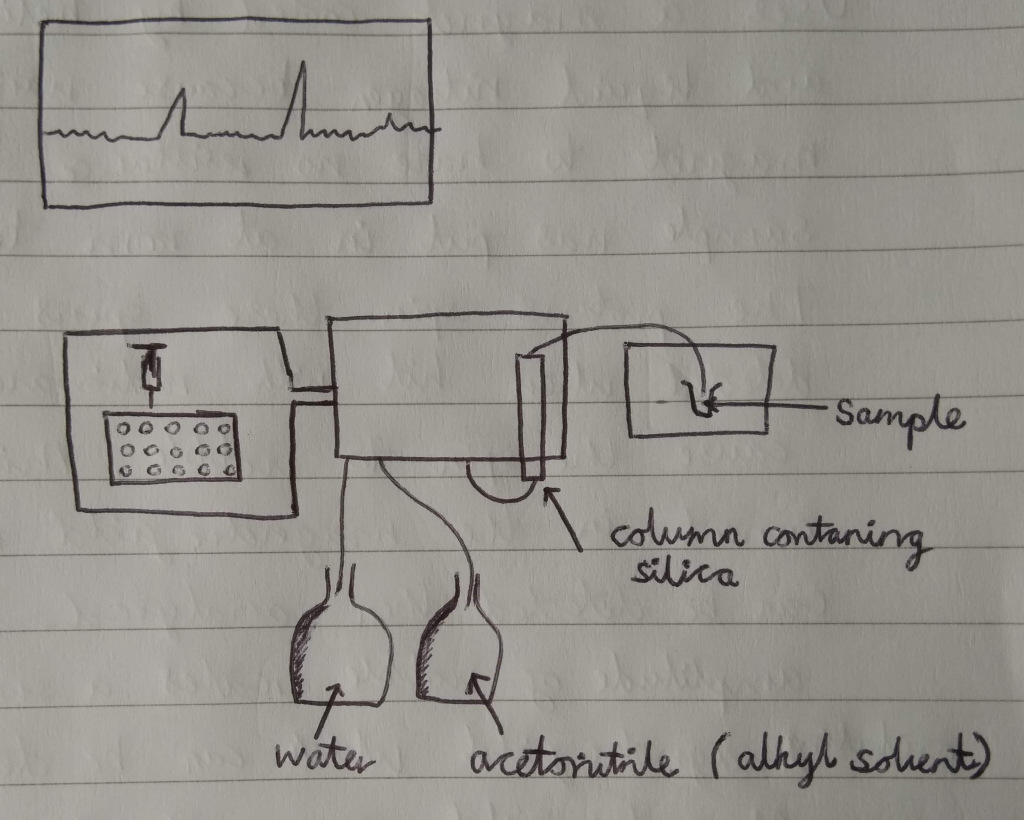
We spent the first part of our morning with Victoria, who has recently completed her PhD on pharmaceutical chemistry and biology. She showed us the automated chromatography machine that separates compounds in relation to polarity. The sample is inserted into the machine and is filtered through a column and treated with adjustable solvent concentrations. Victoria had two compounds that made up the same peak when tested in the analytical.
In order to separate these and identify them a chromatogram was needed. To start, the water (polar) concentration was higher than the acetonitrile (non-polar) concentration and was set to slowly change to higher non-polar concentration. As “like dissolves like” (polar compounds dissolve in polar solution and vice versa) the most polar compound would dissolve first as the water concentration was higher and the most non-polar compound would dissolve after, when the acetonitrile was higher. Throughout, the absorbance of the sample and solvents was recorded and a small volume of the sample was collected when absorbance reached above a certain value. This only happened when one of the compounds had dissolved in the solvent mixture changing the solution’s absorbance. Two peaks would be observed on an absorbance graph, one earlier polar substance and another later non-polar substance. It was extremely interesting to learn about this alternative method.
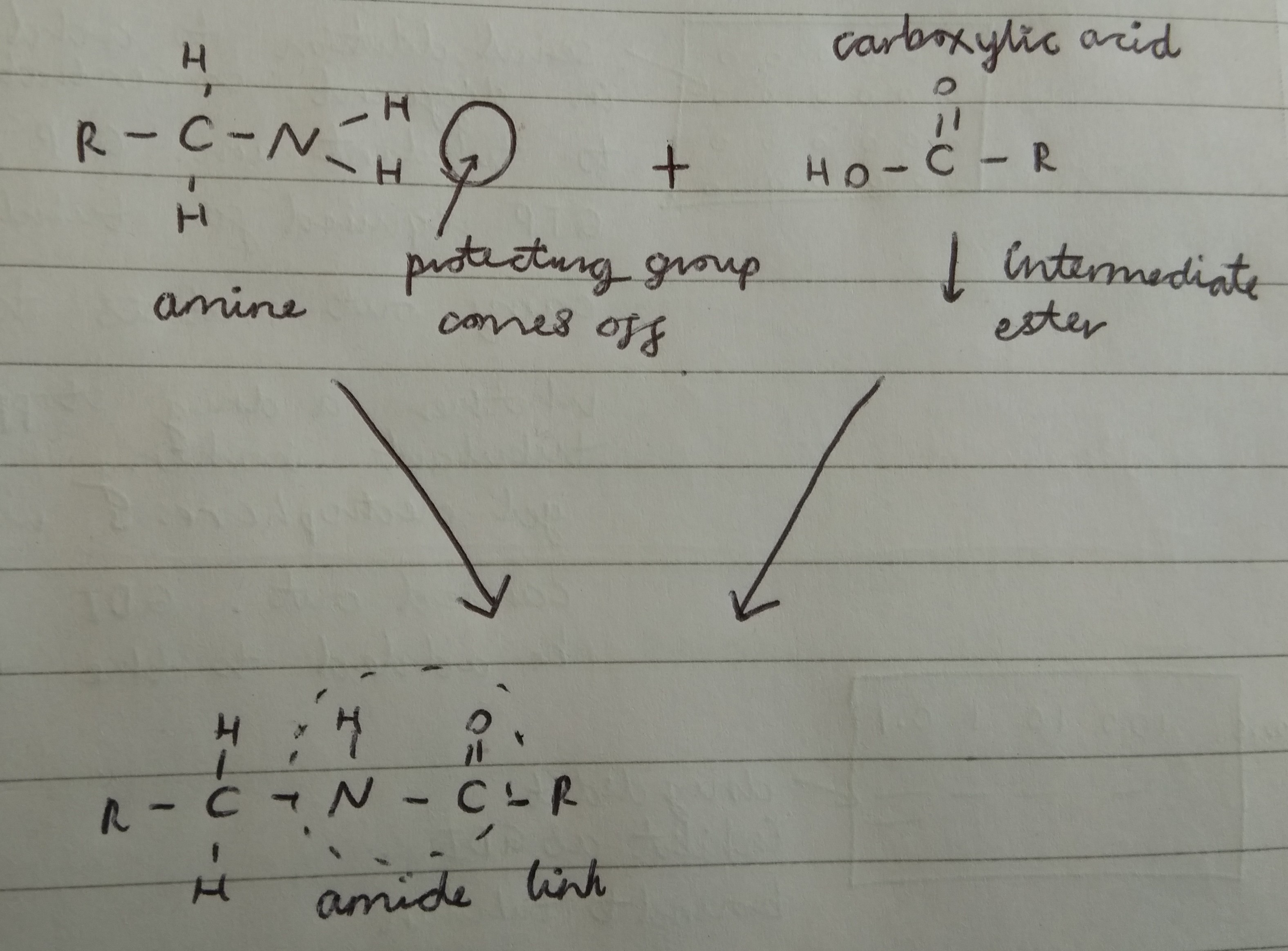
We also worked with Karen on an amide reaction. The new method of forming polypeptides is called a solid phase reaction. It involves small beads that the polypeptides coil around. This has made the process more efficient as it can be completed in only one day whereas before it would have taken a week. It does however have its limitations as the polypeptides produced can’t be more than 50 amino acids long. The reaction combined amino acids that had a protecting group with a carboxylic acid. We were tasked with weighing out the compounds. The solid compounds were added to a vial and syringes were then used to add the liquids. This started the reaction, and then a sonicator and vortex were used to ensure the compounds had fully dissolved. A sonicator uses sound waves to agitate particles in a sample. We then left the experiment in the agitator to complete it’s reaction.
We were then shown the two machines used to analyse the structure of proteins or molecules that have been synthesised in the lab. The first was a mass spectrometer, which splits the molecule into positive fragments by bombarding it with electrons, before deflecting the fragments based on their mass to charge ratio. This is used to determine the overall mass of the molecule, in order to help analyse the substances purity, identity and structure. The mass spectrometer was first rinsed with methanol to remove any residual substances before a sample was inserted into the machine. A graph was then produced which displayed the different fragments.
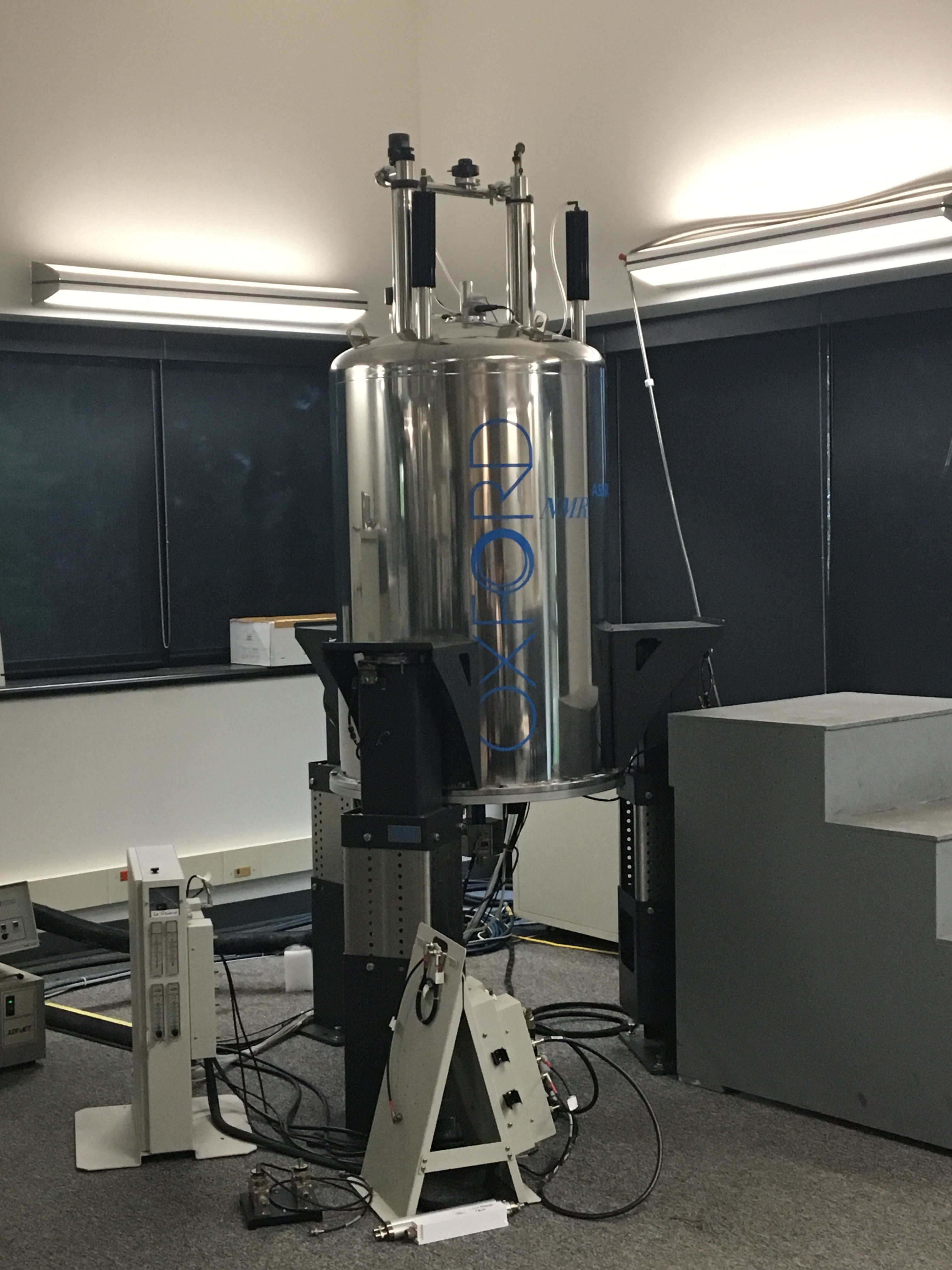
We then got to see how an NMR spectrometer was used to analyse structure and purity. NMR works by placing the substance in the magnetic field. The magnet in the NMR machine is cooled by helium and nitrogen to prevent resistance. The protons in the substance will then either align with the magnetic field, spinning in the same direction or they will spin against the direction of the magnetic field. The sample is then hit by radio waves that causes the spin of the protons to “wobble”. The amplitude of this “wobble” creates an oscillating magnetic field. The greater the strength of the magnet in the NMR, the greater the sensitivity of the machine and the higher the resolution the data. A graph is produced using the data recorded from the NMR machine which can be analysed to determine the various chemical environments of protons within a molecule. This can then be used to determine it’s structure. We all found this topic very interesting to learn more about as it featured in our advanced higher chemistry course.
We thoroughly enjoyed our day at the gunning group and returned to our accommodation to pack for our move back to Toronto.

 Baird of Bute Science Scholarship 2019