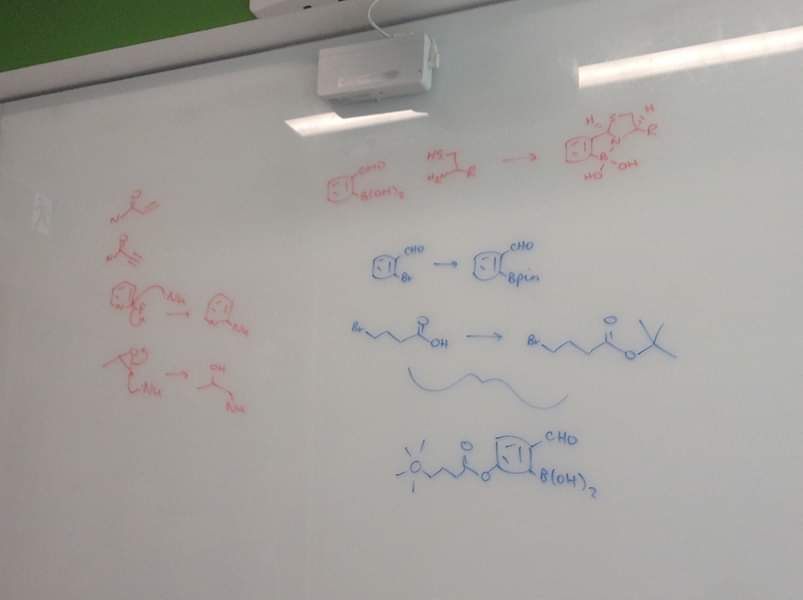
Today we were shadowing Geordie, a student who has just finished his undergraduate degree in biological chemistry. He is currently undertaking a summer research fellowship with the Gunning Group. At the moment he is working on reporter molecules which bind to proteins. This can allow proteins to be found within a cell or can provide a molecule which has the potential to be an effective drug. The reporter molecules he is currently studying involve a CF3 group (fluorescing part). The reporter containing the CF3 can be analysed by using NMR. A shift in the chemical environment of the Fluorine causes a shift in the peak on the NMR graph, which indicates that the reporter has binded to the protein. This shift can then be used to calculate the concentration of reporters binded to the protein or the type of protein it is binded to. The reporters can be modified so they only target specific proteins. Mutated proteins are good drug targets as they are only present in cancerous cells. As part of the research the reporter molecules have to be created. Reporter molecules require complex reaction pathways consisting of many different reactions such as nucleophilic substitution in order to bind to the protein.
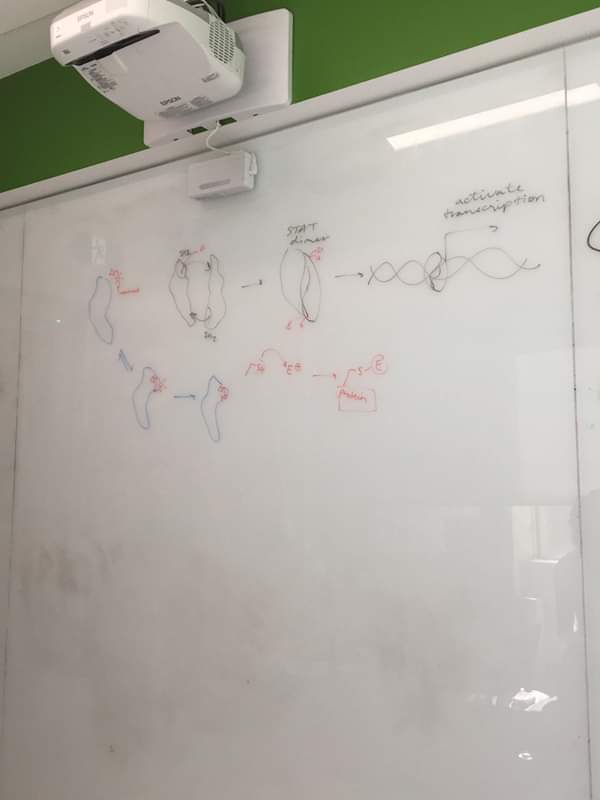
We also had a short talk on one way in which difficulty in designing a drug due to flexible or rigid ligands which bind to specific proteins in cancer cells can be overcome. One example used to illustrate this was STAT 3 proteins which form bonds with each other to form a STAT dimer, which is a transcription factor which regulates growth and division. In cancerous cells, too many STAT 3 proteins bind to form transcription factors, resulting in an uncontrolled increase in cell growth and division. Drugs that target the binding site of the STAT 3 are ineffective as an equilibrium is reached between the bound and unbound ligand, meaning transcription factors are still produced. In order to overcome this, a covalent warhead is attached to the drug, which forms a permanent covalent bond with the binding site of STAT 3, preventing the production of transcription factors, thus reducing the rapid rate of growth and division of cancer cells. However, issues arise with targeting cancer cells, as STAT 3 is very similar in cancerous and healthy cells and essential in the regulation of growth and development. In addition, the warhead used must not be too reactive or other proteins may be affected, having unforeseen consequences on human cells. This method can be used to treat not only cancer, but Duchenne muscular dystrophy, Crohn’s disease and psoriasis.
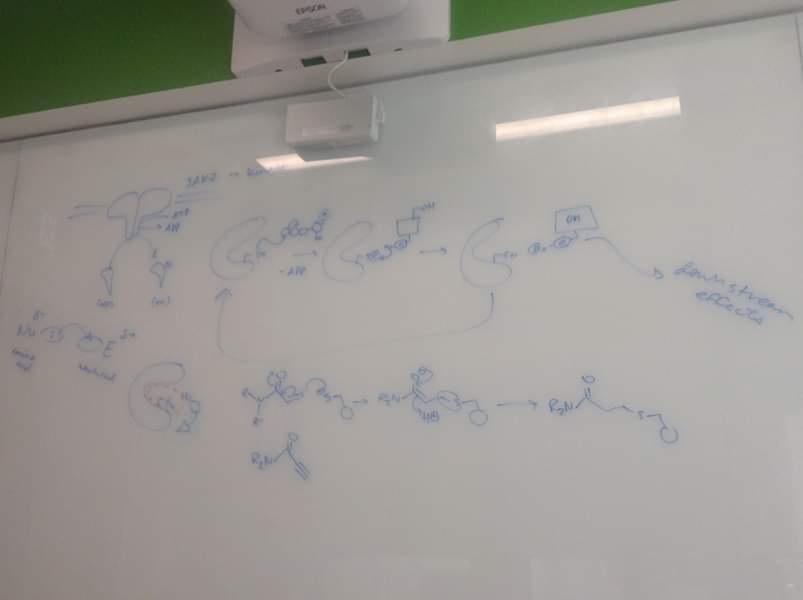
STAT 3 undergoes post translational modification by JAK 2 (a type of kinase) in order to become functional. Kinases are specific to the substance it phosphorylates, which means kinase inhibitors (a type of antagonist) can be used to target STAT 3 and not other proteins, minimising the drug’s toxicity.
For a drug to be successful it has to fall within the “therapeutic window”. This is when the dosage of a drug is high enough to have positive effects but not so high that it reaches toxicity. A drug that needed such high dosage to have little positive effect before becoming toxic would not be suitable for human use.
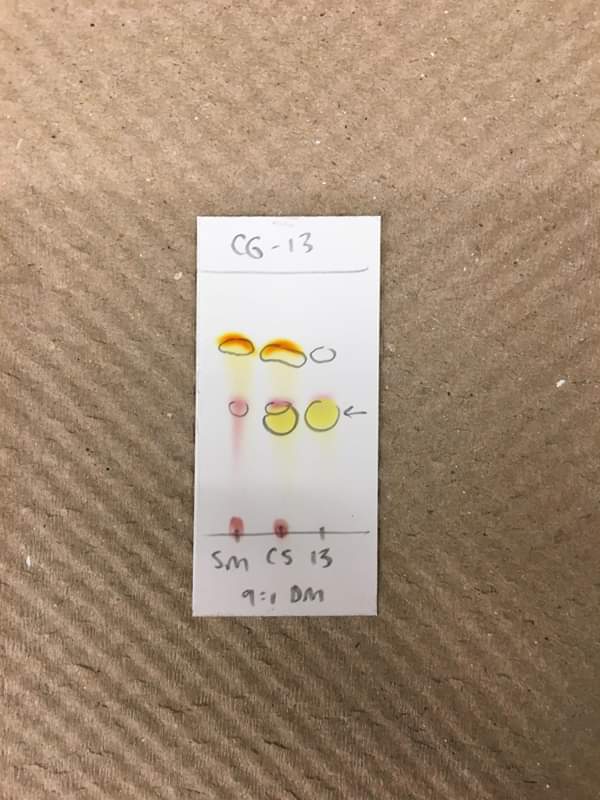
After lunch we returned to the lab and tested the product of one of Geordi’s earlier experiments using thin layer chromatography (TLC). Three dots of solution (one being pure product, one being the sample substance and the other a combination of the two known as the co-spot) were dropped on a line drawn on a piece of TLC paper and placed, upright in a solvent. After the solvent had travelled up the paper we analysed it under UV light in order to see the spots out with the visible spectrum. Specific to our investigation the solvent was one that only the desired product was soluble in, meaning that if the sample spot moved from its original position it was the product. It was exciting to see invisible spots appear under UV light and to have an insight into the different methods of composition determination.
We then went back to our accomodation and had a movie night together in the common room, it was a lovely end to the day.

 Baird of Bute Science Scholarship 2019